
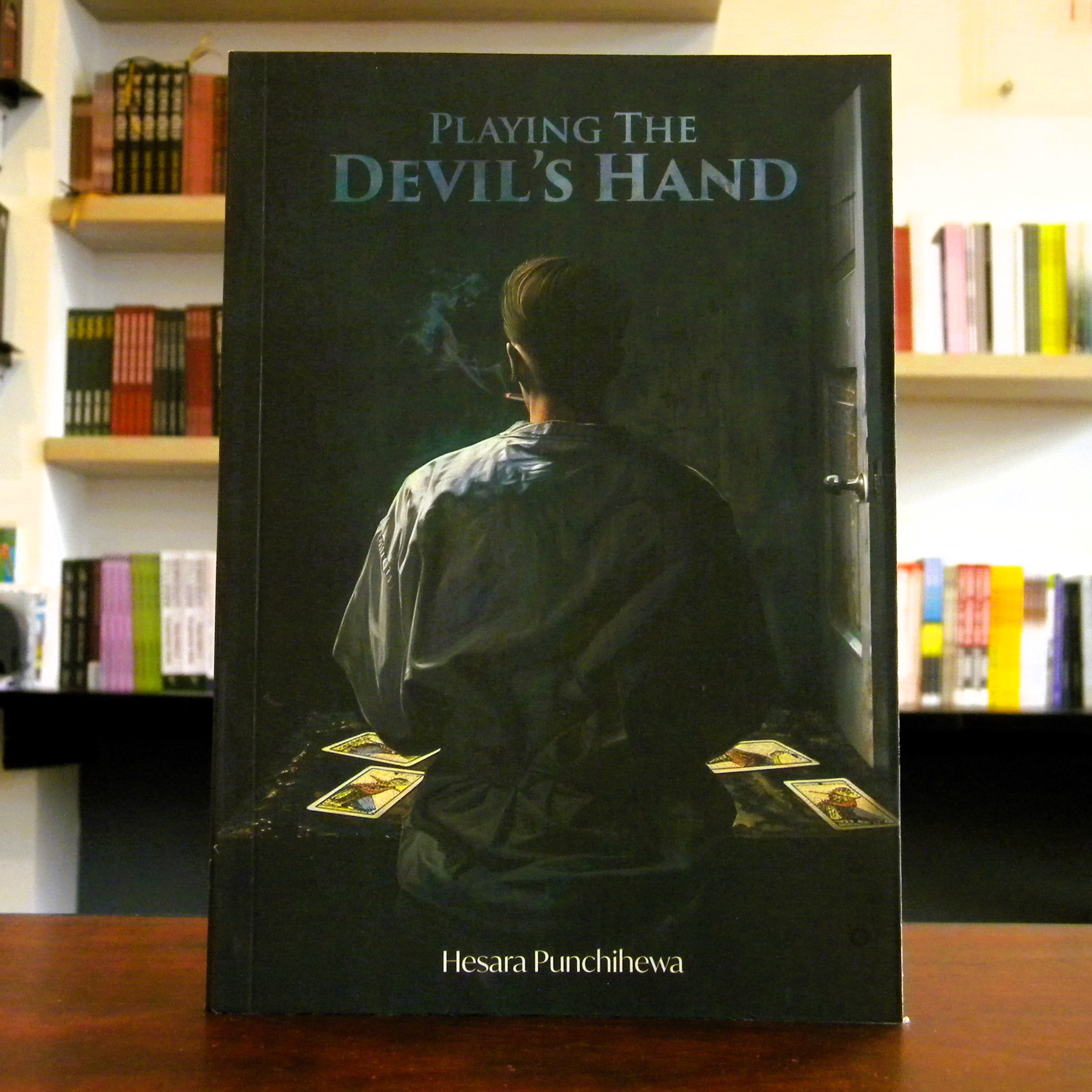
“I like to believe that I’m a very simple person, trying to make a tangible difference in a world that’s urgently in need of it,” said Hesara Punchihewa, author of Playing the Devil’s Hand, which was recently published through The Jam Fruit Tree Publications. Professionally, he’s a twenty-five-year-old medical student undergoing the fifth year of his MBBS degree. Whilst being a writer of English fiction, Hesara also aspires to keep producing meaningful and eye-opening works of fiction that address the most pressing and dire issues of our present social sphere.
“My journey as a writer, I believe, was sparked at a rather young age. As a little kid who was mesmerised and inspired by the likes of brilliant minds like JK Rowling, Charles Dickens and Louisa May Alcott, it was my undying dream to one day give my own novel out into the world,” said the author. Hesara’s first attempt at a completed manuscript was at the age of twelve. Since then, he has had several failed attempts at getting his first novel published. “I was never much of a technologically advanced person – I suppose I’m still not – and hence, I found myself handwriting these manuscripts on single-ruled exercise books,” noted Hesara. This process, of course, took so much more time than the traditional way of typing the manuscript on software. With time, after several of these failed attempts, his first novel, A LIE OF A LIFE gets published in the year 2020, at the age of twenty-one. This was his first real significant win, in terms of his career as an author.
Hesara believes his writing has definitely taken a turn since his first publication. With a lot of material from his own personal experiences now being incorporated into his work, it has transcended on its own. “After all, I do believe that every character, and every story, created by a writer is in fact put together with bits and pieces of the writer himself,” he said.
The inspiration for Playing the Devil’s Hand never came from one clear-cut source of inspiration, or from one particular incident or person. The core purpose of this creation was to address a collection of stigmatised notions and social grey-spots that had been crying out to be addressed for a long while now. This novel is an attempt at bringing to light a handful of less-spoken social and psychological issues that revolve around mental disease, intercultural interactions, Sri Lankan culture and the tourism culture in Sri Lanka.
Playing The Devil’s Hand mainly focuses on the significance of mental health, the silent struggle against mental disease and the utterly crucial battle against social stigmatisation of mental disease.
Whilst these vital aspects remain the cornerstone of this work of fiction, the book addresses pressing current issues in the country, like the Easter Sunday Attack and its residual aftermath on the Lankan people. It bears evidence for conversations that people might sometimes not like to have – topics that might be deemed as taboo for some.
The book also takes the readers on an entertaining deep dive into Sri Lankan culture as witnessed from a foreigner’s perspective, while also taking the reader on a critical, satirical journey through both the good and bad aspects of the controversial, customary ways of the Lankan people.
The author wouldn’t say that the writing process for this book ever came in a uniform flow. The process, at times smooth and at times sporadic, was constantly testing. “I believe the biggest challenge for the process was structuring the writing process in such a way that would allow me to balance my writing with my medical career, which was also demanding on the other hand,” he said. “But as strenuous as it was, I believe I definitely enjoyed the process.” It was overwhelming at times for Hesara, but he came up with a technique to keep up with his consistency when working. Hesara has allocated a specific window of time each day, where he just sits in his writing corner. However, he admits that it doesn’t always work. In fact, during the first bits of the story, he mentioned that it rarely works. But the trick is not get up until that allocated window of time has closed. There are days when he would just sit there, having nothing on his mind and nothing on his manuscript. “But I still don’t get up. And I’ve learned to practice this every day until the book that I’m working on has been completed,” he said.
The main challenge for Hesara, as mentioned before, was definitely finding the right balance between his writing and medical careers. Allocating the right amount of time for each, whilst also not causing damage or taking anything away from the other. Creating that sustainable symbiotic relationship between the two was certainly the toughest task for him.
Besides that, it was also quite a challenging period for him when he first started English fiction writing. When he started his first book, Hesara was around seventeen years old, and for me to complete and get an English novel published in Sri Lanka was a very far-fetched idea at the time. Because, for me personally, I never had anyone to really look up to as he began to make attempts at English writing. “At the time, I never personally knew anyone who had done it before. It was much later, during my second publication, that I came across my wonderfully supportive publishing house ‘The Jam Fruit Tree Publications’ led by the brilliant Jeremy Muller,” he said.
“I would say that when I started, I was pretty much in the dark,” Hesara said. So much so, that during his first novel many years ago, he had no idea how the process of writing a book even works. Being the sixteen-year-old kid I was, he started by handwriting the entire novel on three full notebooks. It was much later that he got accustomed to using computers and other devices to write.
“The most memorable moments were during the times when I would construct my characters while constantly going to my closest people for opinions.” Here, he would definitely have to mention Anna Viktharovna, Nethma Wijayasiri and Dinangi De Silva, who have been his constant pillars of support through this book. Sharing, analysing, constructing and creating these wonderful characters are the best memorable moments from this book for him.
Another unforgettable memory for the author is the final two nights of completing his manuscript. He was on a very strict deadline, since I was going to be in Sri Lanka for a limited time in the coming months, and he had to get the book ready to be launched then. Along with this weight, it just so happened that my neurology final examination was the next day. That entire week Hesara had been writing, with faint little bits of reading neurology here and there. It was on the night before my neurology final examination that he had to decide to choose to finish my manuscript on time, instead of preparing for one of the toughest examinations the next day. “My friends stuck by my side all night. I somehow ended up finishing the manuscript on time for my editor, and also passing the neurology final examination the next morning,” he recalled fondly.
“I hope my story provides a helping hand for anyone who has a loved one, or a close one, going through any form of mental tussle that they cannot put into words. Hopefully to understand them a bit better,” the author said. He hopes this story helps other people see these silently suffering people in a new, different way, and pushes the dire fight of shattering the chronic social stigmatisation of mental disease, at least by one tiny step.
Hesara explained that mental disease is invisible. It has no colour, no smell, no texture. And this allows it to easily seep into our day-to-day lives. It is, perhaps, the disease of camouflage. It’s up to us to make sure that the people we love do not have to suffer while sitting, smiling and living right next to us.
All in all, Hesara hopes that his story left something out there for someone to make their life or the life of a loved one a little bit better.
Words by Gayanga Dissanayake